The Fabrication Threshold: A Structural Law of Information Systems
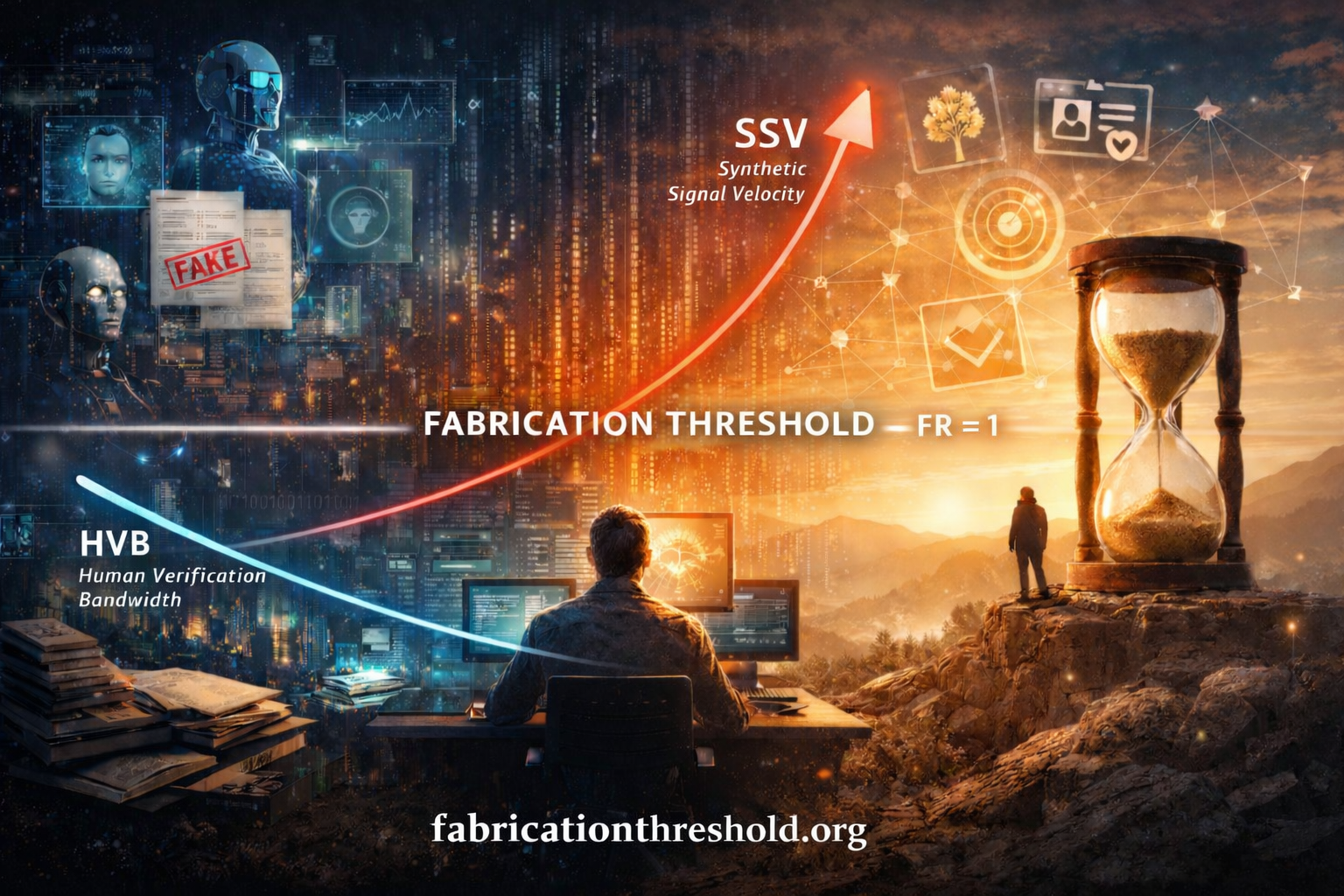
When synthetic signal velocity exceeds human verification bandwidth, the system does not degrade. It ceases to function.
Abstract
This paper introduces the Fabrication Threshold — a proposed structural law governing the reliability of information systems in the age of artificial intelligence. The law states that every system relying on isolated signals for verification has a measurable threshold, expressed as the Fabrication Ratio (FR = SSV / HVB), beyond which the system’s output becomes structurally indistinguishable from noise. The paper defines the core terms, establishes the threshold’s binary nature at the system level, examines five domains where the threshold is being approached, explains why conventional responses accelerate rather than prevent collapse, and identifies the architectural response that structurally reduces FR. The Fabrication Threshold is offered as a framework for policy, research, and institutional assessment — testable, falsifiable, and open to refinement.
The Fabrication Threshold is a structural law of information systems. It is not related to fabrication thresholds in materials science or semiconductor engineering.
1. The unspoken assumption
Every information system that has ever functioned — from oral reputation networks to digital identity platforms — has operated on a single unspoken assumption: that the cost of producing a convincing false signal is high enough to keep false signals rare relative to true ones.
This assumption was never articulated because it never needed to be. For the entirety of human civilization, the cost of fabrication acted as a natural governor. A forged document required a forger with skill. A fabricated credential required institutional complicity. A false identity required sustained, disciplined performance over time. A fraudulent scientific paper required enough genuine expertise to be plausible.
The cost was never infinite. False signals have always existed. But their frequency remained below the threshold at which systems could still distinguish real from fabricated — and that was sufficient. Systems functioned not because they eliminated fabrication, but because the economics of fabrication kept it manageable.
The threshold itself was always there — as real as the boiling point of an ocean that had never been heated. No one named it because no one needed to.
This paper argues that artificial intelligence — and specifically generative AI capable of producing synthetic content, identities, and credentials at near-zero marginal cost — has structurally altered the economics of fabrication — not incrementally, but categorically — and that the consequences of this alteration can be described by a single law.
2. The law
The Fabrication Threshold is defined as follows:
Every information system that verifies isolated signals has a structural threshold. Below it, the system functions — verification outpaces fabrication and the system’s output is usable. Above it, the system fails — fabrication outpaces verification and the system’s output becomes noise indistinguishable from signal.
The threshold is expressed as a ratio:
FR = SSV / HVB
Where:
Synthetic Signal Velocity (SSV) is the rate at which synthetic signals — fabricated identities, generated credentials, simulated behavioral patterns, manufactured content — can be produced and introduced into the system. SSV is a function of available computation, model capability, and the structural complexity of the signal being fabricated. With current AI capabilities, SSV is scaling exponentially across all signal types.
Human Verification Bandwidth (HVB) is the rate at which a system can verify the authenticity of signals using human judgment, institutional processes, and temporal assessment. HVB is constrained by three structural limits: the biological capacity of human cognition, the irreducible cost of human time, and the throughput of institutional verification processes. These constraints are not inefficiencies to be optimized. They are properties of what verification is.
Fabrication Ratio (FR) is the quotient of the two. It measures the structural condition of any information system at any given moment.
When FR < 1: verification outpaces fabrication. False signals exist but remain a manageable minority. The system’s output is imperfect but usable.
When FR = 1: the system reaches equilibrium. Error rates rise. Confidence decreases. The system appears to function but is structurally strained.
When FR > 1: the Fabrication Threshold has been crossed. Fabrication outpaces verification. The system does not stop — it continues to operate, continues to produce output, continues to certify. But it can no longer determine which of its signals are authentic, and its output becomes structurally unreliable.
When FR > 1, the marginal value of every signal in the system approaches zero — because no signal can be trusted without verification that the system can no longer provide.
3. The binary property
The most consequential feature of the Fabrication Threshold is that it is not gradual. It is functionally binary at the system level.
This requires explanation, because it contradicts intuition. Most people assume that systems degrade smoothly as synthetic signals increase — that a system contaminated with 10% false signals is 90% reliable, and a system contaminated with 50% false signals is 50% reliable.
This is incorrect. And the reason is structural, not statistical.
Trust is operationally binary at the system level. A recruitment platform either identifies competent candidates reliably or it does not. A verification service either confirms identity reliably or it does not. A publication system either filters truth from fabrication reliably or it does not.
A system where half the signals are synthetic and half are real does not produce half-reliable output. It produces output that is entirely unreliable — because the system cannot label which half is which. The contamination is not in the proportion. It is in the uncertainty. Once the system can no longer guarantee that any given output is verified, every output becomes suspect — including the ones that are genuine.
This is the threshold property: below FR = 1, the system’s errors are manageable and identifiable. Above FR = 1, the system’s output is uniformly suspect. There is no smooth transition between these states. There is a boundary — and the boundary is invisible from the approach.
At FR = 0.8, the system appears to function normally. At FR = 0.95, the system appears to function with slightly more friction. At FR = 1.01, the system has crossed the threshold. It continues to produce output. It continues to verify. It continues to certify. But its certifications have lost their structural foundation.
The system does not know it has crossed. The threshold does not announce itself. It is visible only in retrospect — and by then, the damage is cumulative and irreversible.
This is the structural tragedy of every threshold event: the system is designed to monitor incremental changes. It has dashboards for error rates, metrics for fraud detection, KPIs for verification accuracy. All of these measure the approach — the slope of the curve. None of them measure the threshold itself. The system watches the temperature rise and does not know that it is approaching a phase change — because phase changes are not visible on a gradient.
4. Five domains approaching the threshold
The Fabrication Threshold is not an abstraction. It is a measurable condition approaching specific systems at specific velocities.
4.1 Academic publishing. The peer review system was designed for an era when producing a plausible research paper required years of training and genuine expertise. AI can now generate papers that pass initial editorial screening — complete with fabricated data, synthetic citations, and coherent methodology. The flood of AI-generated research papers has already overwhelmed editors in several fields. The verification system — volunteer peer reviewers with limited time and no compensation for thoroughness — has not scaled. In several fields, the FR is approaching 1. When it crosses, the distinction between published science and generated noise disappears. The epistemic foundation of evidence-based policy erodes — not because science is wrong, but because the filter that separates science from fabrication has lost its capacity.
4.2 Recruitment. The hiring process was built on the assumption that credentials, work histories, and references reflect genuine human experience. AI can generate all three — synthetic resumes tailored to any position, fabricated credentials optimized for any screening algorithm, AI-generated references indistinguishable from authentic ones — at near-zero cost. Recruiters verify manually, spending minutes per application. The FR in recruitment is rising faster than in almost any other domain, because the incentive for fabrication is high (employment) and the cost is low (approaching zero). When the threshold is crossed, the system does not select for competence. It selects for optimization — which is precisely what AI does best.
4.3 Digital identity. Identity verification systems check attributes at a point in time — documents, biometric data, behavioral patterns, knowledge-based questions. AI can produce synthetic versions of each category — AI-generated identity documents, deepfake biometrics, simulated behavioral patterns that pass automated checks. The verification industry responds with additional layers — which creates additional surfaces to fabricate. The FR in digital identity is locked in a structural race where every defensive move expands the attack surface. The threshold is not a fixed point. It is a moving boundary — moving in fabrication’s favor.
4.4 Democratic processes. Electoral integrity depends on the ability to distinguish authentic public sentiment from manufactured signals. AI can generate voter communications, simulate grassroots movements, produce synthetic polling data, and manufacture public opinion at scale — AI-driven disinformation that is indistinguishable from organic political discourse. The verification capacity of electoral systems — fact-checkers, journalists, oversight bodies — operates at human speed. The FR in democratic processes is approaching the threshold in a domain where the consequences of crossing it are not commercial but civilizational.
4.5 Financial markets. Market function depends on the assumption that signals — earnings reports, analyst assessments, trading patterns, news — reflect reality. AI can generate synthetic market signals across all categories simultaneously — AI-fabricated earnings narratives, algorithmically manufactured trading patterns, synthetic analyst reports. Market verification relies on auditors, regulators, and analysts — all operating at human bandwidth. When the FR crosses the threshold, market signal becomes structurally indistinguishable from market manipulation — and no amount of regulatory oversight at human speed can restore the distinction.
Each system has a different current FR. Each is moving at a different velocity. All are moving in the same direction. None has an architectural mechanism to reverse the trajectory within its current verification model.
5. Why conventional responses accelerate collapse
The standard institutional response to rising FR is more verification: more identity checks, more compliance layers, more AI-powered detection systems, more behavioral analysis, more fraud prevention.
This response is not neutral. It is structurally counterproductive.
The reason is embedded in the ratio itself. Every new verification layer operates on the same logic as the system it protects — it checks isolated data points. A new identity check adds a new attribute to verify. A new compliance layer adds a new credential to confirm. A new detection system adds a new behavioral pattern to analyze.
But every new data point to verify is also a new data point to fabricate. The cost of adding a fabrication target is lower than the cost of adding a verification step. The defender pays in institutional processes, human time, and systemic complexity. The attacker pays in computation — which is asymptotically approaching zero.
The net effect is that FR increases with each additional layer of point-based verification. The system is attempting to solve an asymmetric problem with a symmetric response. In an asymmetric contest, the side with lower marginal cost always wins.
This is why institutional responses to the Fabrication Threshold consistently fail. Not because the institutions are incompetent. But because the tools available to them operate on the same logic as the threat — verifying isolated points in a world where isolated points can be manufactured at negligible cost.
An ontology cannot diagnose its own failure. It can only experience it as a series of escalating operational problems that never quite get solved.
6. The architectural response
If point-based verification worsens the Fabrication Ratio, the question becomes: what changes it?
The answer is a shift in what is being verified — from signals that can be fabricated at zero cost to processes that require actual human duration.
Fabrication can produce any signal. It cannot produce duration.
A contribution sustained over years cannot be generated in seconds. A competence demonstrated across a decade of changing contexts cannot be simulated backwards. A truth that survives twenty years of independent scrutiny cannot be manufactured on demand. A relationship confirmed by multiple independent parties over extended time cannot be fabricated without fabricating the parties, their histories, and their contexts — a cost that scales exponentially rather than approaching zero.
Time-based verification does not increase HVB. It changes the nature of what is verified. Against temporal processes, SSV drops — because synthesis has no duration. The Fabrication Ratio inverts.
This is the only architectural response that structurally reduces FR within systems that rely on isolated signals.
The web was built to transport information. It was never designed to carry meaning. The Fabrication Threshold shows why that distinction now matters: in a world where any signal can be fabricated, only systems that carry meaning — verified identity, temporal competence, contribution that persists — can maintain FR below 1. The next infrastructure is not a faster web. It is a semantic one.
7. Scope and limitations
The Fabrication Threshold is a proposed structural law governing the reliability of information systems in the age of artificial intelligence. It is not a proven natural law. It is a framework — testable, falsifiable, and open to refinement.
The Fabrication Threshold is not a measure of signal proportion. It is a measure of production velocity relative to verification capacity — and it predicts system failure, not signal degradation. This distinguishes it from classical signal-to-noise analysis, which measures ratio within a functioning system. The Fabrication Threshold measures the point where the system itself ceases to function.
The framework does not predict dates. Different systems have different current FRs and different trajectories. What the framework provides is a method for assessing where any given system stands and in which direction it is moving.
The framework does not prescribe political action. It describes a structural condition. How institutions, nations, and organizations respond is a matter of policy, not of the law itself.
The framework does not claim that all verification will fail. It claims that verification of isolated signals will fail when fabrication of those signals becomes cheaper than detection — and that this condition is approaching across multiple critical domains simultaneously.
Empirical estimation of FR requires domain-specific proxies for SSV and HVB. Precise quantification may not yet be possible in every domain. But relative acceleration between fabrication throughput and verification throughput is observable and measurable in most institutional contexts — and it is the direction and rate of change, not the absolute value, that determines whether a system is approaching its threshold.
The Fabrication Threshold is a tool for understanding — offered with the conviction that understanding a structural condition is the precondition for surviving it.
8. Conclusion
The Fabrication Threshold has always existed as a structural property of information systems. It never needed to be named because the conditions for crossing it — fabrication at near-zero cost — did not exist until artificial intelligence removed the cost barrier that had protected every information system for the entirety of human history.
The barrier is gone. The law is in effect.
Every system that verifies isolated signals is now on a trajectory toward its threshold. Some have not yet approached it. Some are approaching it. Some have already crossed it without knowing — because the threshold is invisible from the inside, and the system continues to produce output long after that output has lost its structural foundation.
They will not experience the crossing as a crisis. They will experience it as a mood — a slow, pervasive erosion of confidence, a sense that credentials mean less, that expertise is harder to verify, that information is less reliable than it used to be. That mood is not cultural. It is structural. It is the lived experience of systems operating above their Fabrication Threshold.
Verification has a human speed limit. Fabrication does not. That is the law. Everything else is a consequence.
Rights and Usage
The Fabrication Threshold, including its definition, formula (FR = SSV / HVB), and all associated terminology, is released under Creative Commons Attribution–ShareAlike 4.0 International (CC BY-SA 4.0).
Anyone may use, cite, translate, adapt, and build upon this framework freely, with attribution to FabricationThreshold.org.
How to cite: FabricationThreshold.org (2026). The Fabrication Threshold: A Structural Law of Information Systems. Retrieved from https://fabricationthreshold.org
No exclusive licenses will be granted. No commercial entity may claim proprietary ownership of the Fabrication Threshold, its formula, or its terminology.
The definition is public knowledge — not intellectual property.