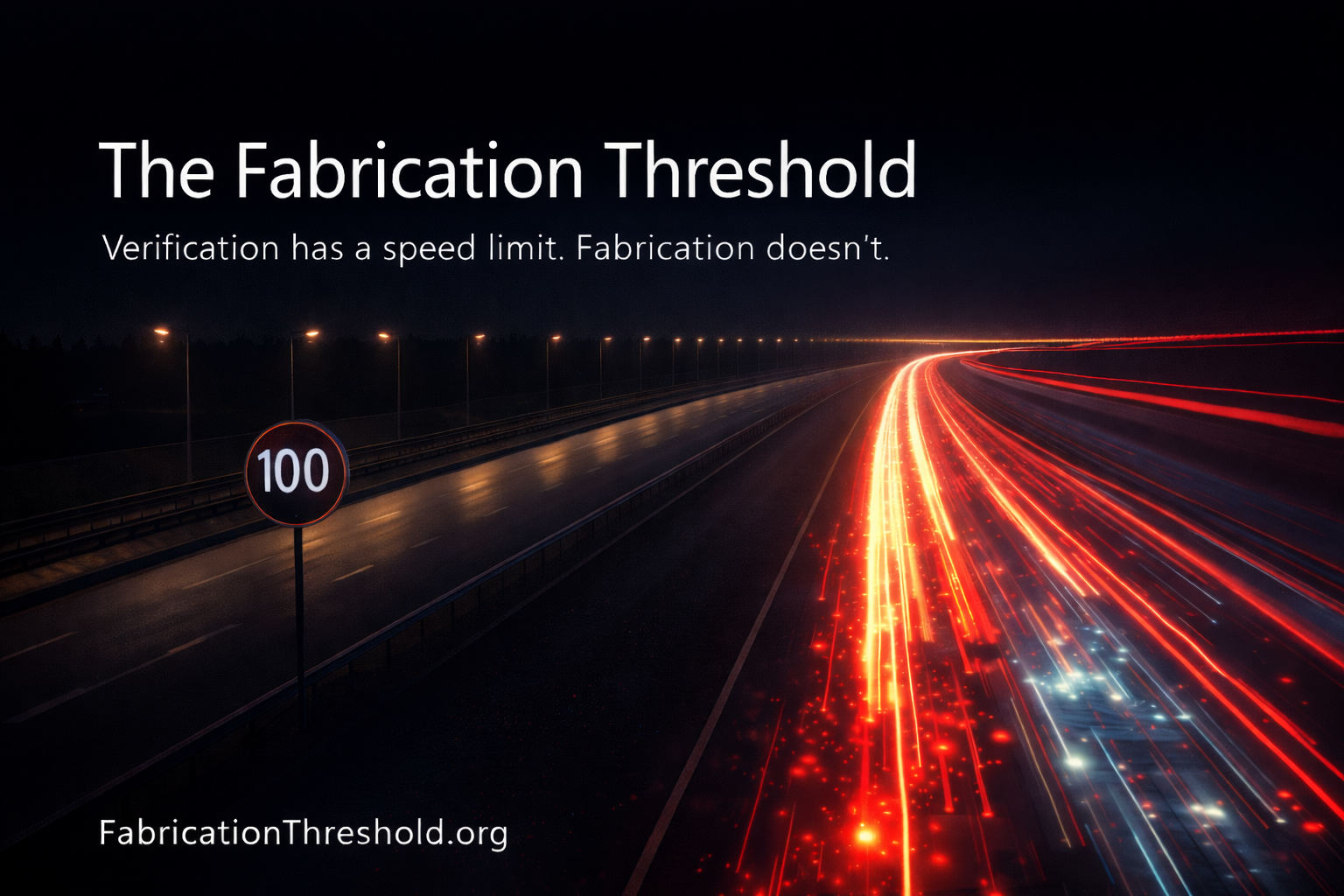
The Fabrication Threshold
Verification has a speed limit. Fabrication doesn’t.
Fabrication Threshold (FT): A structural law of information systems. The point where synthetic signal velocity exceeds human verification bandwidth. Expressed as FR = SSV / HVB. When FR > 1, the system does not stop. It continues to operate — but its verification function has collapsed and its outputs are structurally unreliable. The transition is binary, not gradual.
Not to be confused with fabrication thresholds in materials science or semiconductor engineering. This is a structural law of information systems.
For the entire history of human civilization, every system of trust has operated on one assumption: that producing a convincing false signal costs more than detecting one. That assumption kept fabrication below verification speed — not perfectly, but sufficiently. Systems functioned because the ratio favored the verifier.
AI has inverted the ratio. The cost of producing synthetic signals is asymptotically approaching zero — across every domain. The cost of verifying them has not changed. Verification is constrained by human cognition, institutional process, and irreducible time. These are not inefficiencies. They are structural properties of what verification is.
The result is a measurable condition:
FR = SSV / HVB
SSV — Synthetic Signal Velocity: the rate at which fabricated signals can be produced and introduced into a system.
HVB — Human Verification Bandwidth: the rate at which the system can verify signal authenticity using human judgment, institutional process, and temporal assessment.
FR < 1 — the system functions. Verification outpaces fabrication.
FR > 1 — the system fails. Fabrication outpaces verification. Every signal becomes suspect — including the genuine ones.
This threshold is being crossed, at different speeds, across the trust systems that society depends on: academic publishing flooded by AI-generated research papers, recruitment pipelines overwhelmed by synthetic resumes and fabricated credentials, digital identity systems racing against AI-produced synthetic identities, democratic processes targeted by manufactured public opinion at scale, and financial markets exposed to AI-generated signals indistinguishable from legitimate trading activity. The standard institutional response — more checks, more layers, more AI fraud detection — accelerates the crossing, because every new point-based verification layer creates a new surface to fabricate.
The only architectural response that structurally reduces FR is a shift from verifying isolated signals to verifying temporal processes — because fabrication can produce any signal, but it cannot produce duration.
The Fabrication Threshold is a proposed structural law governing the reliability of information systems in the age of artificial intelligence. It describes the structural limits of verification in AI-accelerated environments. It is testable, falsifiable, and open to refinement.
Explore the structural context at IsolationEconomy.org →
The Fabrication Threshold, its formula (FR = SSV / HVB), and all associated terminology are released under Creative Commons Attribution–ShareAlike 4.0 International (CC BY-SA 4.0). Anyone may use, cite, and build upon this framework with attribution to FabricationThreshold.org.
The definition is public knowledge — not intellectual property.
Verification has a human speed limit. Fabrication does not. That is the law.