FAQ
Frequently Asked Questions
Understanding the Fabrication Threshold — what it is, why it matters, and where it leads.
The Fabrication Threshold is a structural law of information systems. It is not related to fabrication thresholds in materials science or semiconductor engineering.
What is the Fabrication Threshold?
The Fabrication Threshold is a proposed structural law governing the reliability of information systems in the age of artificial intelligence. It describes the point in any system where synthetic signals can be produced faster than human beings and institutions can verify them. When that point is crossed, the system does not stop. It continues to operate — but its output becomes structurally indistinguishable from noise.
The law is expressed as a ratio: FR = SSV / HVB. SSV is Synthetic Signal Velocity — the rate at which fabricated signals can be produced and introduced into a system. HVB is Human Verification Bandwidth — the rate at which the system can verify authenticity using human judgment, institutional processes, and temporal assessment. When FR exceeds 1, the threshold has been crossed.
Is this a proven law?
No. It is a proposed structural law — a framework for understanding a specific condition in information systems. It is testable, falsifiable, and open to refinement. It makes a specific, measurable claim: that the ratio between fabrication speed and verification speed determines system function, and that the transition from function to failure is functionally binary at the system level. These claims can be empirically tested in specific domains. That is what makes it a useful framework rather than an opinion.
Has the Fabrication Threshold always existed?
Yes. The threshold is a structural property of information systems — it does not depend on AI. Any system that relies on signals to establish truth, identity, or value has a point where fabrication can outpace verification. This has been true since the first reputation system, the first credential, the first document.
What is new is not the threshold. What is new is that the conditions for crossing it now exist. For the entire history of human civilization, the cost of fabrication acted as a natural brake. Producing convincing false signals required effort, skill, time, and risk. That cost kept fabrication below verification speed in every system that mattered. Generative AI has reduced that cost to the point where it is asymptotically approaching zero — across every domain simultaneously. The threshold that was always there is now being approached for the first time.
It was like naming the boiling point of the ocean. AI changed the temperature.
Why is this happening now?
Because the cost of fabrication has changed — not incrementally, but categorically.
For four centuries, producing a convincing false signal required human effort proportional to the signal’s complexity. A forged credential required a forger. A false identity required sustained performance. A fabricated research paper required genuine expertise. The cost of fabrication acted as a structural brake — it did not eliminate false signals, but it kept them rare enough for verification systems to manage.
Generative AI removed that brake. The cost of producing a synthetic identity, a fabricated credential, an AI-generated research paper, a convincing behavioral pattern is now approaching zero — across every domain simultaneously. The cost of verifying those signals has not changed. Verification still requires human cognition, institutional process, and irreducible time.
The result is a divergence that cannot be closed within any architecture that verifies isolated data points. Fabrication is scaling exponentially. Verification is not scaling at all. The two curves crossed — and in most systems, they will not cross back.
This is not a temporary disruption. It is a permanent structural shift in the economics of information systems.
How is this different from the signal-to-noise problem?
Signal-to-noise analysis measures the proportion of useful signal relative to noise within a functioning system. It assumes the system is working and asks how well it is working.
The Fabrication Threshold measures something different: the point where the system itself stops working. It is not a measure of signal proportion. It is a measure of production velocity relative to verification capacity. A system with a high noise ratio can still function if it can identify which signals are real. A system that has crossed the Fabrication Threshold cannot — because it has lost the ability to make that distinction at all.
Signal-to-noise is a performance metric. The Fabrication Threshold is a survival condition.
Why does the threshold behave as a binary transition rather than a gradual decline?
Because trust at the system level is operationally binary. A recruitment platform either identifies competent candidates reliably or it does not. An identity verification service either confirms identity reliably or it does not. A publication system either filters genuine research from fabrication reliably or it does not.
A system where half the signals are synthetic does not produce half-reliable output. It produces entirely unreliable output — because the system cannot label which half is which. The contamination is not in the proportion of false signals. It is in the uncertainty that applies to every signal once the system can no longer guarantee verification. Below FR = 1, errors are identifiable. Above FR = 1, every output is suspect — including the genuine ones.
A recruitment platform that correctly identifies competent candidates 50% of the time is not half-functional. It is useless — because no one can determine which 50% to trust.
This is why institutions that have crossed the threshold do not notice immediately. The system continues to produce output. It continues to certify. But the certifications have lost their structural foundation. The crossing is visible only in retrospect.
What does this have to do with Descartes and the isolation economy?
The connection is structural, not metaphorical.
In 1637, René Descartes defined the human being as an isolated point of consciousness — separated from relationships, context, and time. That definition was a philosophical experiment. But it became, without anyone choosing it, the structural foundation of every institution and every digital system built in the four centuries that followed.
A user profile is that definition in database form. A credential is that definition in institutional form. A behavioral signal is that definition in algorithmic form. An identity check is that definition in security form. Every digital system built on the Cartesian model treats the isolated data point as its fundamental unit of value.
This architecture is what IsolationEconomy.org calls the isolation economy — the structural logic that makes isolated data points the foundation of trust, identity, competence, and truth in every information system.
The Fabrication Threshold is what happens when that foundational unit becomes free to produce. It is the mathematical expression of the isolation economy reaching its structural limit. The connection is not thematic. It is causal: the isolation economy created systems that verify isolated points. AI made isolated points fabricable at zero cost. The Fabrication Threshold describes exactly when and why those systems fail.
Without the isolation economy, there would be no civilizational threshold — because systems built on temporal processes rather than isolated points do not have the same vulnerability. The threshold exists precisely because the foundational unit was always an isolated signal. And isolated signals are exactly what fabrication can produce.
Which systems are closest to crossing the threshold?
Based on the structural properties of each domain — the cost of fabrication relative to the capacity of verification — five systems are approaching the threshold at the highest velocity:
Academic publishing, where AI-generated research papers can be produced faster than volunteer peer reviewers can assess them — complete with fabricated data, synthetic citations, and coherent methodology.
Recruitment, where synthetic resumes, fabricated credentials, and AI-generated references can be produced at near-zero cost against manual screening processes that spend minutes per application.
Digital identity, where AI-produced synthetic identities, deepfake biometrics, and simulated behavioral patterns can be generated to match every attribute on any verification checklist — and where every new verification layer creates a new fabrication surface.
Democratic processes, where AI-driven disinformation, synthetic polling data, and manufactured public opinion can be generated at scale against electoral oversight that operates at human speed.
Financial markets, where AI-fabricated earnings narratives, algorithmically manufactured trading patterns, and synthetic analyst reports can be produced across all signal categories simultaneously against regulatory verification at human bandwidth.
Each system has a different current FR. Each is moving at a different speed. All are moving in the same direction. None has a mechanism within its current architecture to reverse the trajectory.
Why does adding more verification make things worse?
Because the standard response — more identity checks, more compliance layers, more AI-powered detection systems — operates on the same logic as the system it is trying to protect. It adds more isolated data points to verify.
But every new data point to verify is also a new data point to fabricate. The cost of adding a fabrication target is lower than the cost of adding a verification step, because fabrication costs computation and verification costs human time. Computation is approaching free. Human time is not.
The net effect is that FR increases with each additional layer of point-based verification. The defense and the attack operate on the same logic, and the attacker has lower marginal cost. The system is treating an asymmetric threat with a symmetric response. In asymmetric contests, the side with lower cost always wins.
This is why the Fabrication Ratio does not improve with more verification of the same type. It can only be altered by changing the type of signal being verified — from something fabricable at zero cost to something that requires irreducible human duration.
Can the threshold be reversed?
Not within any architecture that verifies isolated signals. The cost asymmetry is permanent: fabrication costs computation, which is approaching free. Verification costs human time, which is biologically fixed. No institutional reform, no regulatory framework, no increase in verification staffing reverses that asymmetry. It can only be managed — and it can only be managed by changing what is verified.
If a system shifts from verifying isolated data points to verifying temporal processes — contribution sustained over years, competence demonstrated across changing contexts, relationships confirmed by independent parties over time — then SSV drops, because synthesis has no duration. The Fabrication Ratio inverts. The threshold is not reversed. It is structurally bypassed — by building systems where the unit of verification is something fabrication cannot produce.
The question for any institution is not ”how do we get back below the threshold?” It is ”can we build an architecture where the threshold does not apply?”
What is the architectural response?
A shift from verifying isolated signals to verifying temporal processes.
Fabrication can produce any signal. It cannot produce duration. A contribution sustained over years cannot be generated in seconds. A competence demonstrated across a decade of changing contexts cannot be simulated backwards. A truth that has survived twenty years of independent scrutiny cannot be manufactured on demand. A relationship confirmed by multiple independent parties over extended time cannot be fabricated without fabricating the parties, their histories, and their contexts — a cost that scales exponentially rather than approaching zero.
When verification shifts from isolated points to temporal processes, SSV drops — because synthesis has no duration. The Fabrication Ratio inverts. This is the only architectural response that structurally reduces FR within systems that rely on isolated signals.
In practice, this means: identity defined as continuity rather than credential. Competence proven through persistence rather than certification. Trust built through relational history rather than attribute verification. Truth validated through endurance rather than virality.
These are not ideological positions. They are the structural requirements for maintaining FR below 1 in any information system that matters.
What practical use does the Fabrication Threshold have?
Four primary uses.
First, as a diagnostic tool. Any institution can assess its own FR by estimating its current verification capacity relative to the fabrication velocity it faces. This is not a precise measurement — but it does not need to be. A system at FR = 0.3 is structurally different from a system at FR = 0.9, and knowing which side of the threshold you are approaching changes the nature of the decisions you make. The framework converts a vague sense that ”things are getting harder” into a structural assessment with directional clarity.
Second, as a policy framework. Regulators currently treat AI-generated synthetic content as a security challenge — focusing on detection, identification, and penalization. The Fabrication Threshold shows why detection-based policy is structurally untenable: detection is a form of verification, and verification has a human speed limit. Policy built on the slow side of an exponential asymmetry will fail. The framework provides an alternative basis for AI governance and regulation: focus not on detecting fabrication, but on building systems where the unit of verification is structurally resistant to fabrication — temporal, relational, and process-based.
Third, as a strategic framework for organizations. Companies whose business models depend on the reliability of isolated signals — advertising platforms monetizing engagement, recruitment platforms verifying credentials, identity verification companies selling attribute checks — can use FR to assess the structural viability of their model. A business model with rising FR is a business model on a trajectory toward failure. A business model built on temporal verification has structural durability that no amount of point-based optimization can replicate.
Fourth, as a predictive model. Because FR is a ratio of two measurable forces — fabrication velocity and verification capacity — it can be used to forecast when a system is likely to approach its threshold. Institutions can track the trajectory of their FR over time, identify inflection points, and anticipate structural failure before it becomes visible. This transforms the Fabrication Threshold from a descriptive framework into a predictive one — comparable to epidemiological models that forecast system strain before collapse occurs.
Can FR be measured precisely?
Not yet — and that is acknowledged as a limitation of the framework. SSV and HVB are structural concepts rather than precisely quantifiable metrics in their current form. However, they can be estimated at the domain level. The number of AI-generated papers submitted to academic journals can be approximated. The cost of generating a synthetic identity can be measured. The average time a peer reviewer spends per paper can be quantified. The framework does not require exact values to be useful — it requires directional assessment. Is FR rising or falling? Is it approaching 1 or receding from it? These questions can be answered with available data, and the answers have direct implications for institutional strategy and policy.
Empirical estimation of FR requires domain-specific proxies for SSV and HVB. Precise quantification may not yet be possible in every domain. But relative acceleration between fabrication throughput and verification throughput is observable and measurable in most institutional contexts — and it is the direction and rate of change, not the absolute value, that determines whether a system is approaching its threshold.
The framework explicitly invites empirical refinement. One of its purposes is to provide a structure within which measurement can be developed — a conceptual scaffold for research that does not yet exist but is urgently needed.
Is this only about AI?
No. AI is the trigger, not the cause.
The cause is an architecture that made isolated data points the foundational unit of trust in every information system. That architecture existed for nearly four centuries before AI arrived. AI did not create the vulnerability. AI activated it — by removing the cost barrier that kept fabrication below verification speed.
If a different technology had emerged that could fabricate isolated signals at near-zero cost, the same threshold would apply. The law is about the structural relationship between fabrication velocity and verification capacity, not about any specific technology. AI happens to be the technology that made the relationship visible — but the law itself is technology-independent.
This matters for policy. Regulating AI specifically does not address the structural condition. A system built on isolated data points will face the same threshold regardless of which technology enables the fabrication. The only durable response is architectural — changing what is verified, not controlling what does the fabricating.
What happens to institutions that have already crossed the threshold without knowing it?
They continue to operate — in appearance. The system still produces output. The university still grants degrees. The platform still verifies identities. The journal still publishes papers. The hiring system still selects candidates.
But the output has lost its structural foundation. The degrees may have been earned through AI-generated coursework. The verified identities may be synthetic. The published papers may contain fabricated data. The selected candidates may have fabricated credentials. The institution cannot determine which of its outputs are genuine — and neither can the people who rely on them.
This is the most dangerous phase: the system appears functional while being structurally compromised. Decisions are made based on certifications that may be empty. Careers are built on credentials that may be fabricated. Policies are shaped by research that may be generated. And because the system continues to produce familiar output in familiar formats, there is no visible moment of collapse — only a slow, corrosive erosion of reliability that manifests as a generalized loss of trust.
This is why the Fabrication Threshold is often experienced not as a crisis but as a mood — a vague, pervasive sense that nothing can be fully trusted anymore, that credentials mean less than they used to, that expertise is harder to verify, that information is less reliable. That mood is not cultural. It is structural. It is the lived experience of systems that have crossed their threshold.
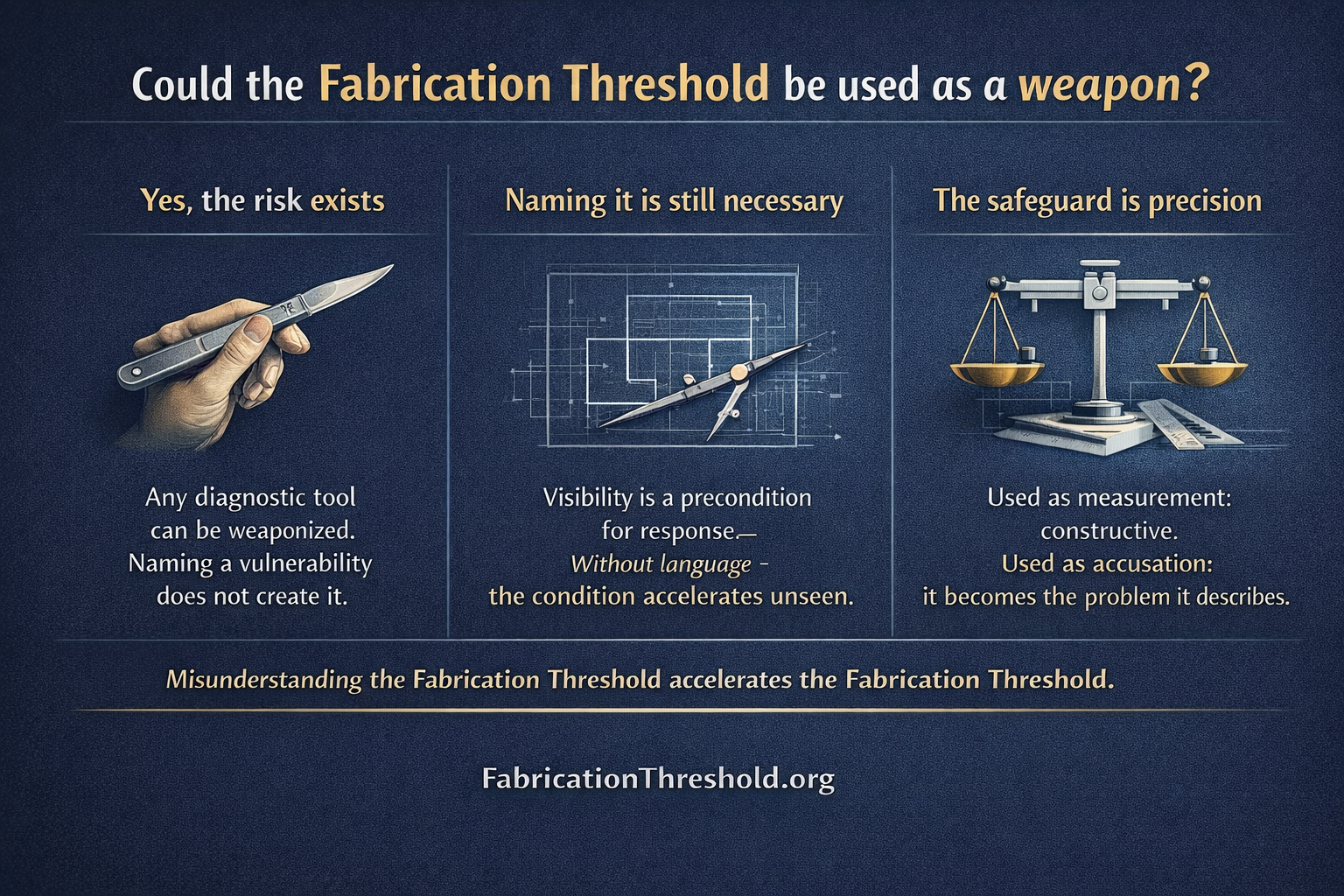
Could the Fabrication Threshold be used as a weapon — to discredit legitimate systems?
Yes, and this risk must be acknowledged. Once the concept of a Fabrication Threshold exists in public discourse, it can be weaponized — used to cast doubt on systems that are still functioning, to undermine trust in institutions that have not yet crossed their threshold, to justify dismantling systems that someone wants removed for political or commercial reasons.
This is a real risk. It is also unavoidable. The structural condition the Fabrication Threshold describes exists whether or not it has a name. Naming it does not create the vulnerability. It makes the vulnerability visible — and visibility is a precondition for response.
A framework that can be misused is still more useful than no framework at all — because without a framework, the same erosion of trust happens anyway, without language, without measurement, and without the possibility of architectural response. The Fabrication Threshold provides tools for assessment. Whether those tools are used constructively or destructively is a matter of human choice, not of the framework itself.
What is the most important thing to understand about the Fabrication Threshold?
That it is not about content. It is not about deepfakes, misinformation, fake news, or synthetic media. Those are symptoms. The Fabrication Threshold is about the structural condition that produces all of them simultaneously — and will continue to produce them regardless of which specific symptom is addressed.
Every policy that targets a specific type of fabrication — deepfake detection, AI content labeling, synthetic media identification — is treating a symptom while the structural condition accelerates. The Fabrication Threshold provides a way to see the condition itself, rather than its individual manifestations.
Verification has a human speed limit. Fabrication does not. That single asymmetry, applied across every information system that relies on isolated signals, produces the entire landscape of problems that institutions are currently struggling with — and will continue to struggle with until the asymmetry itself is addressed.
The asymmetry cannot be resolved by making verification faster. It can only be resolved by changing what is verified — from isolated signals that fabrication produces at zero cost, to temporal processes that fabrication cannot produce at all.
Where can I learn more?
The Fabrication Threshold is a structural law. The isolation economy is the architecture that created the conditions for it. The contribution economy is the architecture designed to survive it.
IsolationEconomy.org provides the full framework: how the isolation economy was built, why it is collapsing, and what replaces it. The Fabrication Threshold is one component of that larger framework — the component that formalizes when and why the collapse occurs.
The two sites are connected but independent. FabricationThreshold.org presents the law on its own terms — usable by researchers, policymakers, and organizations without requiring engagement with the full ontological framework. IsolationEconomy.org provides the structural context within which the law has its deepest meaning.
Both are published under CC BY-SA 4.0. Both are open to citation, adaptation, and refinement. Both exist to provide language for a structural condition that, until now, had no name.
Why does the definition matter?
Because the Fabrication Threshold is itself subject to the dynamics it describes.
Once a structural concept enters public discourse, its meaning becomes part of the system it was created to diagnose. If the Fabrication Threshold is misunderstood, oversimplified, or distorted, institutions may respond to the wrong problem — accelerating the very condition the framework was designed to identify.
A misinterpreted Fabrication Threshold does not merely fail to help. It becomes a new synthetic signal inside the information systems that rely on accurate verification. Distorted definitions raise SSV. Inaccurate interpretations reduce effective HVB. The result is a higher FR — not because of malice, but because imprecision in a structural framework produces structural consequences.
This is why the definition is published in full, under open license, with explicit citation guidance. Not to control the concept — but to ensure that the concept, as it spreads, retains the precision that makes it useful.
The Fabrication Threshold should not be invoked as a rhetorical tool to delegitimize functioning institutions. It is a diagnostic framework, not a political instrument. Its value lies in measurement, not in accusation. Used precisely, it provides language for a condition that every institution is beginning to experience. Used imprecisely, it becomes part of the problem it describes.
Misunderstanding the Fabrication Threshold accelerates the Fabrication Threshold. That is not a paradox. It is the law, applied to itself.
What is temporal verification, and why is it the only architectural response that structurally reduces the Fabrication Ratio?
Temporal verification is the practice of verifying processes rather than points — contribution sustained over time, competence demonstrated across changing contexts, identity established through continuity rather than credential.
It is the only architectural response to the Fabrication Threshold because it is the only form of verification where fabrication costs scale with depth rather than approaching zero. To fabricate a ten-year contribution requires ten years of fabrication. To fabricate a twenty-year institutional history requires fabricating every independent party, every context, every observable consequence across two decades. The cost is structurally proportional to the very thing being verified.
Fabrication can produce any isolated signal instantly. It cannot produce duration, accumulation, or consequence — because these properties require that time actually pass.
This is expressed in the principle Persisto Ergo Didici — I persist, therefore I have learned. Where Descartes defined the isolated thinking subject as the unit of knowledge, temporal verification defines the persisting contributing subject as the unit of trust. Not what can be certified at a point in time. What has been demonstrated over time.
Three properties define a temporal signal. Persistence: the signal exists as a process, not an event. Accumulation: the evidence compounds with each independent confirmation over time. Consequence: the outcome is observable by parties who had no reason to coordinate their documentation.
Together, these three properties describe signals that fabrication cannot replicate at zero cost — and therefore the only architecture where the Fabrication Ratio does not structurally rise.
The deeper the process, the higher the cost of fabrication.
→ Read the full analysis: Persisto Ergo Didici — Why Temporal Verification Is the Only Architecture That Survives the Fabrication Threshold
Misunderstanding the Fabrication Threshold accelerates the Fabrication Threshold. That is not a paradox. It is the law, applied to itself.
Rights and Usage
All materials published on FabricationThreshold.org — including definitions, formulas, and terminology — are released under Creative Commons Attribution–ShareAlike 4.0 International (CC BY-SA 4.0).
Anyone may use, cite, translate, adapt, and build upon this framework freely, with attribution to FabricationThreshold.org.
How to cite: FabricationThreshold.org (2026). The Fabrication Threshold: A Structural Law of Information Systems. Retrieved from https://fabricationthreshold.org
No exclusive licenses will be granted. No commercial entity may claim proprietary ownership of the Fabrication Threshold, its formula, or its terminology.
The definition is public knowledge — not intellectual property.